Cultural & Literary Panels: Why Perspective Matters More Than Conclusions

Community & Civic Panels: Why Every Voice Matters
September 8, 2026
Panel Genres Series | 12 of 15
Not every panel discussion is designed to solve a problem. Some are designed to help us see the world differently. And that is the unique gift of Cultural & Literary Panels.
Whether the setting is a book festival, museum, library, arts conference, literary event, or cultural symposium, audiences come not only to hear ideas, but to explore them. The conversation is less about finding the right answer, but it’s about discovering new perspectives.
You’ll Commonly Find This Genre At…
- Book festivals
- Literary festivals
- Museum events
- Author talks
- Arts festivals
- Humanities conferences
- Historical society meetings
Think…
- National Book Festival
- Miami Book Fair
- Texas Book Festival
- Edinburgh International Book Festival
- Smithsonian programs
If you’re moderating one of these panels, your audience isn’t looking for definitive answers. They’re looking for fresh perspectives that encourage reflection long after the conversation ends.
What Matters Most: Perspective
Cultural and Literary audiences are naturally curious. They want to understand the creative process, the historical context, the personal experiences that shaped a work, and/or the influences behind an artist’s choices.
They are interested in interpretation as much as information and they appreciate conversations that invite reflection instead of rushing toward conclusions.
In this genre, there may not be a single “correct” answer…and that’s perfectly okay!
Success Looks Like…
A successful Cultural & Literary Panel sounds like this: “I never thought about it that way,” “I want to go back and read that again,” or “That conversation helped me appreciate the work in a completely different way.”
Success isn’t measured by agreement; it is measured by expanded perspective. The audience should leave seeing something they thought they already understood through a new lens.
Moderator Superpower: Curation
The moderator’s greatest superpower for a Cultural & Literary panel is curation. Rather than directing the conversation toward a destination, the moderator thoughtfully guides its exploration. They connect themes, invite reflection, and encourage panelists to build upon one another’s ideas.
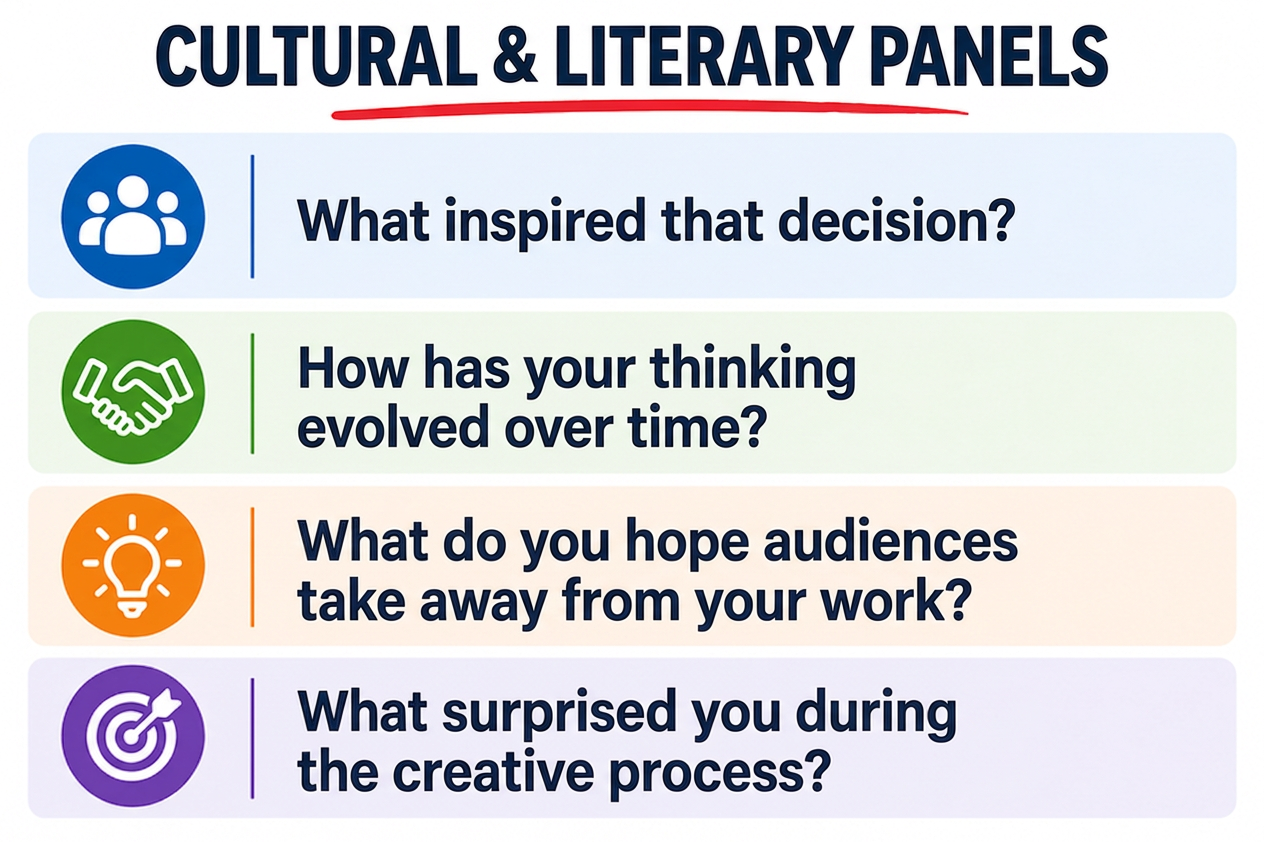
They ask questions such as:
- “What inspired that choice?”
- “How has your thinking evolved over time?”
- “What do you hope readers take away from this work?”
- “What surprised you during the creative process?”
The moderator becomes less of an interviewer and more of a curator of ideas.
The Biggest Pitfall: Chasing the “Right” Answer
Not every conversation needs a conclusion. Sometimes panel moderators feel pressure to summarize the discussion neatly or arrive at consensus. Yet Cultural & Literary Panels often become richer when questions remain open. The audience doesn’t need every mystery solved. Sometimes they simply want more to think about!
How to Design a Better Cultural & Literary Panel
- Choose panelists whose perspectives genuinely complement one another.
- Encourage storytelling alongside analysis.
- Allow silence when reflection is appropriate.
- Invite discussion about process, inspiration, and interpretation.
- Resist the urge to cover too many topics. Depth almost always creates a more meaningful experience than breadth.
The Moderator’s Playbook
Before moderating a Cultural & Literary Panel, ask yourself:
- What ideas deserve deeper exploration?
- Which stories reveal the creative process?
- How can I encourage panelists to respond to one another’s interpretations?
- Where can I invite reflection instead of rushing to conclusions?
- What perspective do I hope the audience gains?
Cultural & Literary Panels don’t succeed because every question is answered. They succeed because new questions are discovered. When moderators create space for thoughtful exploration, audiences leave with a richer appreciation of the work, the creators, and one another.
Next in the Panel Genres Series: Entertainment Industry Panels: Why the Stories Behind the Stories Matter Most.
Related Articles:
The 15 Genres of Panel Discussions
Community & Civic Panels: Why Every Voice Matters
Educational & Training Panels: Why Learning Requires More Than Information