Educational & Training Panels: Why Learning Requires More Than Information

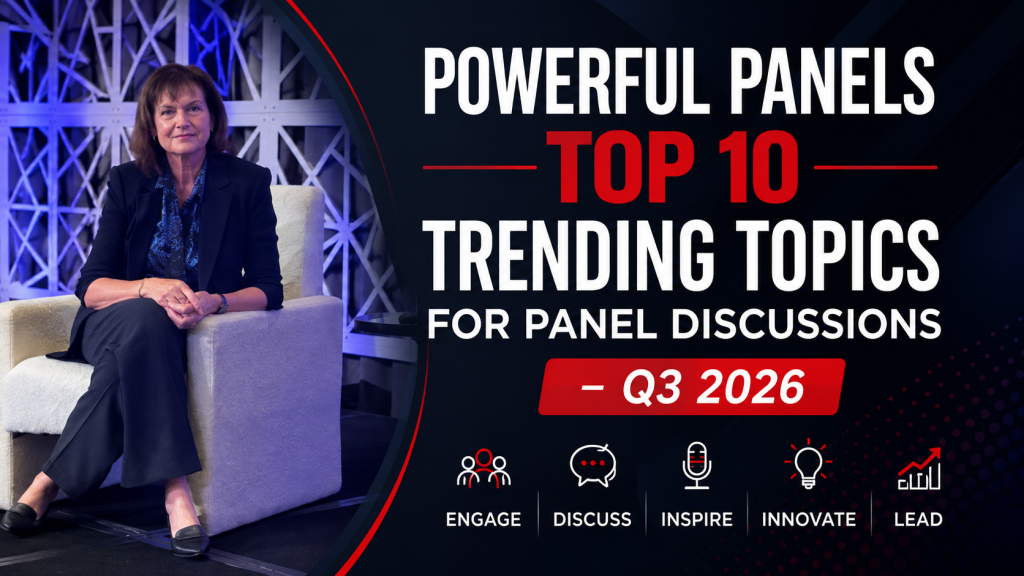
Powerful Panels Top 10 Trending Topics for Panel Discussions – Q3 2026
August 25, 2026
Community & Civic Panels: Why Every Voice Matters
September 8, 2026
Panel Genres Series | 9 of 15
Educational and Training Panels have one purpose: to help people learn.
That sounds obvious, but learning doesn’t happen simply because information is presented.
Think about the best workshop, seminar, or professional development session you’ve ever attended.
Chances are, you don’t remember every statistic or slide.
You remember the idea that suddenly made sense.
The example that connected the dots.
The story that changed your perspective.
Or the practical tip you used the very next day.
That’s what makes Educational & Training Panels different.
The goal isn’t simply to share knowledge.
It’s to create learning.
You’ll Commonly Find This Genre At…
- Professional development conferences
- Training conferences
- Educator conferences
- Continuing education events
- Certification programs
- Learning summits
- Faculty development workshops
Think…
- ATD International Conference
- Learning Solutions Conference
- ISTE
- Training Magazine Conference
- EDUCAUSE
If you’re moderating one of these panels, your audience isn’t just collecting information. They’re looking for ideas they can apply. Help them connect today’s conversation to tomorrow’s actions.
What Matters Most: Application
Learners are constantly asking, “How can I use this?” Information in and of itself has little value unless participants can connect it to their own work. They want examples, case studies, lessons learned, or practical tools. They want help turning concepts into action.
The best Educational & Training Panels don’t overwhelm audiences with information. They help people understand what to do next.
Success Looks Like…
A successful Educational & Training Panel sounds like, “I can’t wait to try that,” “That finally made sense,” or “I’m taking this idea back to my team.”
Success isn’t measured by how much content was covered. It’s measured by how much learning occurred. The audience should leave feeling more confident, more capable, and ready to apply what they’ve learned.
Moderator Superpower: Translation to Action
The moderator’s greatest superpower is Translation to Action.
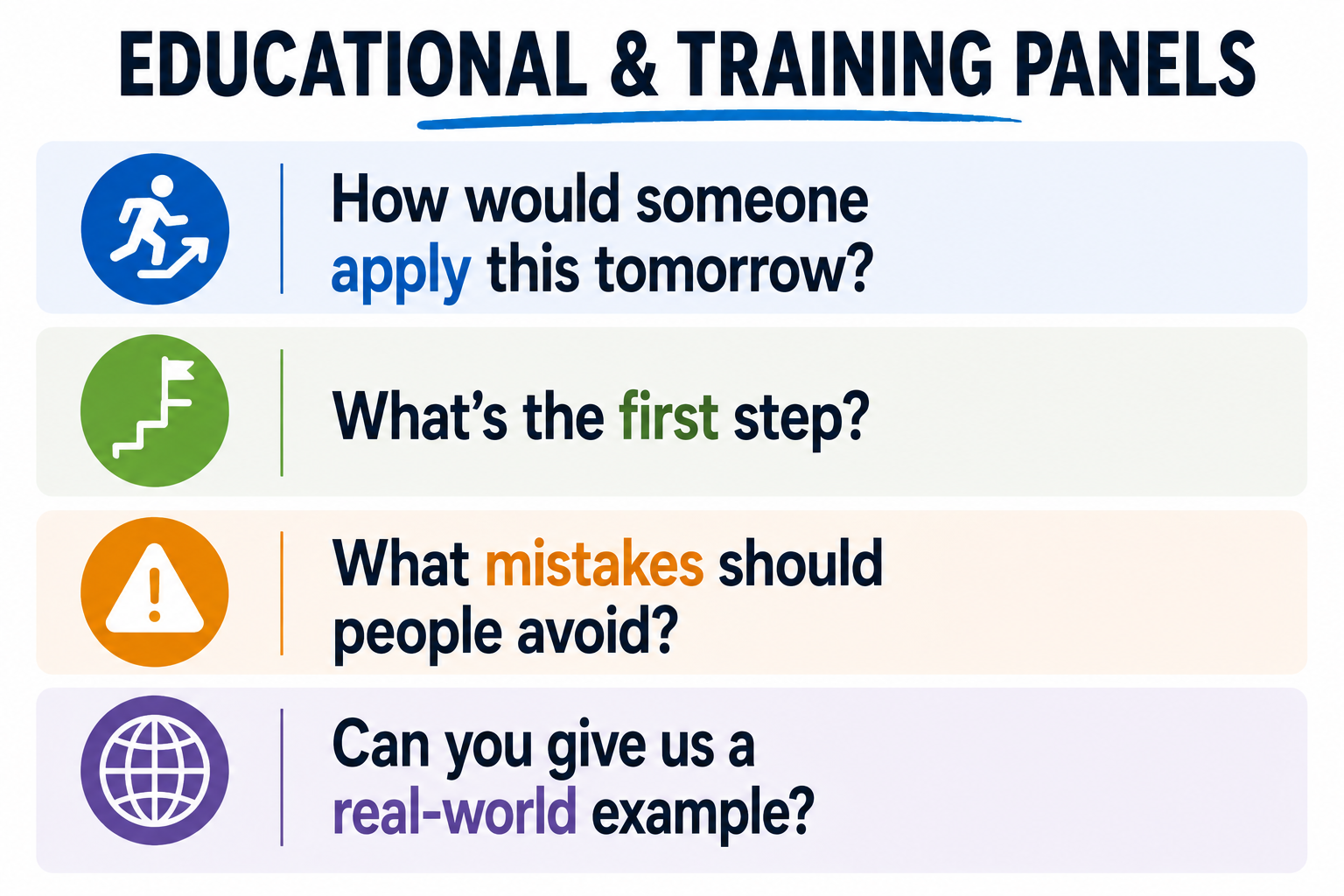
Every discussion should answer one question, “So what? Now what?” As panelists share ideas, the moderator helps connect those ideas to practical implementation. They ask questions that probe further:
- “How would someone get started?”
- “What does this look like in practice?”
- “What mistakes should people avoid?”
- “If our audience only does one thing after today’s discussion, what should it be?”
These types of questions help transform information into action.
The Biggest Pitfall: Information Overload
Educational panels often try to cover too much—too many ideas, too many models, and too many examples. I often describe it as “trying to put 10 pounds into a one-pound bag.” It’s impossible to do well, yet it happens far too often.
Ironically, audiences often learn more when moderators help panelists go deeper instead of broader. Remember this: Learning isn’t about how much information is delivered. It is about how much information is retained and applied.
How to Design a Better Educational Panel
- Choose panelists who are effective teachers, not just subject matter experts.
- Encourage stories and demonstrations instead of lectures.
- Pause occasionally to summarize key ideas.
- Ask panelists to translate theory into practice.
- Help the audience connect the discussion to their own challenges.
Learning accelerates when people can imagine themselves using what they’re hearing.
The Moderator’s Playbook
Before moderating an Educational & Training Panel, ask yourself:
- What should participants be able to do after this session?
- Which examples will make these ideas easier to understand?
- How can I continually connect discussion back to application?
- What follow-up questions will help turn concepts into practical advice?
- What’s the one idea I hope people remember a month from now?
Educational & Training Panels don’t succeed because the speakers know a great deal. They succeed because the audience leaves knowing what to do with that knowledge. When moderators continually bridge the gap between ideas and implementation, learning becomes action. And that’s when education has its greatest impact.
Next in the Panel Genres Series: Community & Civic Panels: Why Every Voice Matters.
Related Articles:
The 15 Genres of Panel Discussions